
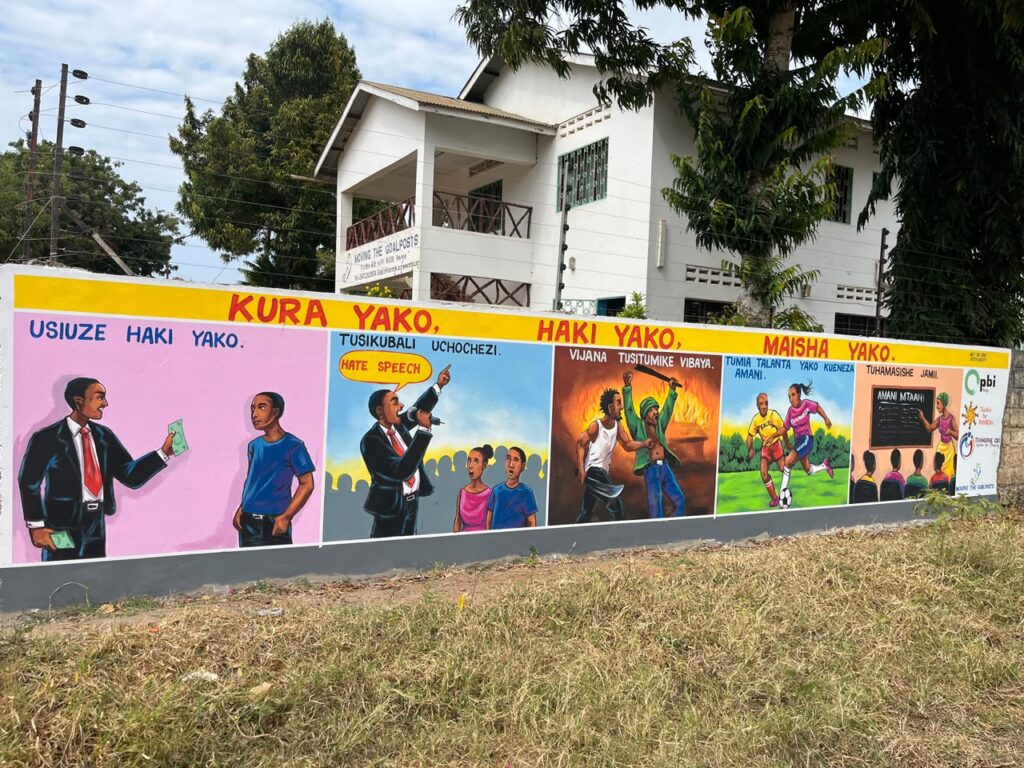
What happens when a community picks up paintbrushes instead of waiting for someone else to tell its story?
In Mnarani Ward, Kilifi, the answer is increasingly visible on walls.
Through the Murals for Peace Initiative, Tuungane CBO has been using art as a platform for dialogue, expression and peaceful coexistence. The annual initiative is supported by Peace Brigades International (PBI) through the Toolkit Organizers initiative, of which Tuungane is part.
So far, three murals have been created in Mnarani Ward, while the wider network of Toolkit Organizers has collectively delivered 12 additional murals across Kibarani, Tezo, Ganda and Shella wards in Kilifi and Malindi.
But these are not simply colorful walls. They are community stories.
Painting peace together
The mural-making process brings together young people, artists, community members and other local stakeholders to imagine and create messages that speak to their realities.
This spirit of co-creation is central to the initiative.
Rather than treating the community as a passive recipient, residents participate in shaping the artwork and the conversations behind it. Through this process, a physical wall becomes a shared expression of what the community values including peace, unity, inclusion and respect.
And that ownership matters.
When communities help create something, they are more likely to value it, protect it and carry its message forward.
Where sport meets art
For Tuungane, the connection between sport and art is deliberate.
Sport brings people together through teamwork, competition and shared experiences. Art creates space for expression, reflection and dialogue. Together, they provide powerful platforms for young people and communities to connect beyond their differences.
The football pitch and the mural wall may look like very different spaces, but both can teach the same lesson: we can share space, work together and achieve something collectively.
From mural to community ownership
The work does not end when the painting is complete.
A post-mural forum provides an opportunity for the community and partners to reflect on the process, discuss the messages captured in the murals and consider how the work can continue contributing to peaceful coexistence.
The initiative culminates in the formal handover of the murals to the community, reinforcing an important principle: the murals belong to the people who helped create them and the community that will live with their messages.
The handover is therefore both symbolic and practical: the community becomes the custodian of the artwork and its message.
More than paint on a wall
Across Kilifi and Malindi, the Murals for Peace and GBV Prevention Initiative is demonstrating the power of community-led action.
With every brushstroke, young people and residents are not only transforming physical spaces; they are creating opportunities for conversation, connection and collective responsibility. Because sometimes, change begins with something as simple as a community coming together to paint a wall and deciding, together, what they want that wall to say.